What Is Enterprise AI?
Jeffrey Erickson | Content Strategist | March 10, 2026

The primary challenge for teams tasked with implementing AI in large enterprises is to make its reasoning and outputs a trusted part of people’s everyday workflows. Only then can AI deliver relevant insights, generate better communications, and make decisions as part of agentic operations. Let’s explore the evolving approaches to enterprise AI that allow it to meet these objectives.
What Is Enterprise AI?
Enterprise AI is the application of generative artificial intelligence and related technologies to complex business workloads. It often begins with choosing a large language model (LLM) and fine-tuning it to understand the language and business logic of an area of operations, such as finance or supply chain, or of a particular industry, such as healthcare, retail, manufacturing, or finance. Enterprise AI systems then augment the model with an organization’s unique data and fit the outputs neatly into daily operations where they can immediately add value. This can result in, for example, an efficient invoice workflow where an AI agent runs in the background scanning data, checking for fraud and compliance, and flagging employees when there’s an anomaly.
As the AI model becomes familiar with the enterprise’s data stores and documents, it can provide deeper insights and more reliably automate tasks, such as personalizing marketing materials, helping sales agents offload busywork and sharpen their communications, or supporting app development and IT operations, such as coding, bug detection and fixing, and documentation.
The imperative to incorporate AI only increases as foundation models continue to improve their understanding of subtle verbal, written, or visual cues and increase their ability to reason based on vast amounts of varied data.
At a similar clip, GenAI systems are improving their ability to generate appropriate outputs. These include text, graphics, video, computer code, and even SQL queries. To achieve this, enterprise AI systems are tending toward moving AI models to where enterprise data already lives, with shared semantics, embedded data governance, and direct integration into operational systems. In that way, the AI system inherits the supporting infrastructure of mission-critical workloads—robust processing power, access controls, data security, and backup and recovery systems.
A popular path to enterprise AI is through business applications, as top-tier vendors introduce AI-infused modules into current workflows. Another common option is to use an AI data platform, which brings AI models together with enterprise data and compute resources so that developers can quickly build, test, and deploy AI agents and applications.
In the end, the success of enterprise AI efforts depends on integrating AI models with established, governed data flows for more trusted reasoning and insights.
Key Takeaways
- Enterprise AI harnesses machine learning and GenAI capabilities to address business problems.
- Enterprise AI differs from consumer AI in that it integrates with corporate data flows and data governance systems to deliver outputs relevant to a particular organization.
- Enterprise AI systems rely on high-availability architectures and often exist in multicloud implementations.
- The promise of AI for enterprise customers has spawned a growing ecosystem of model builders, AI integrators, and hyperscale cloud platforms designed to support mission-critical business operations.
Enterprise AI Explained
Enterprise AI is more than simply large organizations using AI. It’s a process where AI models and AI agents reason over governed enterprise data. This way, the AI systems share business definitions and operational semantics that already run the business and can be embedded into daily workflows.
To be useful, AI decisions and outputs must be trusted. Unlike consumer or experimental AI, enterprise AI is built to be secure, explainable, and scalable, so its intelligence can become a trusted part of daily business outcomes.
Leading enterprise AI systems can gain this trust by inheriting it from the same data governance foundation used for financial reporting, compliance, and core operations. Unlike common consumer AI systems, enterprise AI is more context aware, with an understanding of the language of a particular business. And it’s grounded in the logic that defines existing operations. These AI systems are often adapted to existing workflows within business applications where decisions are made, giving the LLM a defined field of operations where it can move from passive adviser to active participant in real-time, mission-critical operations.
Why Is Enterprise AI Important?
Enterprise AI systems are important because they have the potential to power ubiquitous, intelligent agents embedded in business workflows. AI systems can serve in an advisory role by making data analytics more accessible through natural language inquiries; they can also execute, validate, and manage business processes on their own. Increasingly, these AI systems inherit trusted data processes from the core businesses, allowing them to collaborate across systems to achieve tasks.
The result of these trends is visible in automated factories, autonomous vehicles, and increasingly capable and personalized customer service chatbots. Behind the scenes, enterprise AI systems are bringing efficiency to business workflows as AI supports better, faster, and more strategic decisions for a range of industries.
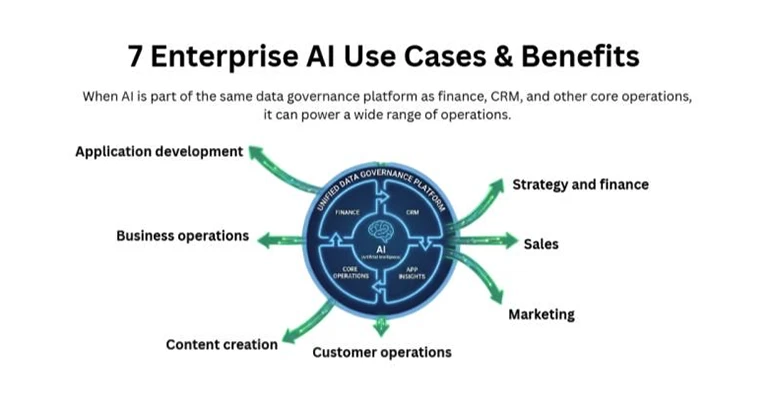
7 Enterprise AI Use Cases and Benefits
Enterprise AI systems have become an integral part of many organizations’ core business systems. As you’ll see in the use cases below, AI helps with strategic planning as well as daily decision-making in these and other mission-critical workflows.
1. Application development: LLMs help development teams by providing drafts of code, reviewing code, automating documentation, and managing other routine IT operations in the development and testing of software.
2. Business operations: Enterprise AI has evolved to a point where it can be part of the same trusted enterprise data flows that inform financial reporting, fraud detection, and strategic decision-making. By inheriting the compute power and data governance from these systems, enterprise AI systems have become trusted partners for back-office operations in HR, logistics, manufacturing, healthcare, and many other sectors.
3. Content creation: Businesses in a wide array of industries, such as insurance, supply chain, and finance, are accelerating the creation of a wide range of content by using an AI assistant to research and draft common documents. Once approved, documents can be translated into multiple languages.
4. Customer operations: By connecting with enterprise data and document stores, automated customer service interactions can provide more personalized service. They can understand customer sentiment, examine a customer’s purchase history, stay up-to-date on past interactions, and converse in the customer’s native language or dialect.
5. Marketing: Companies can achieve targeted outreach and improve customer nurture efforts on a massive scale using AI agents that have access to buyer profiles and purchase histories. The agents can then generate relevant, engaging pitches in seconds that are designed to appeal to a particular customer.
6. Sales: AI-powered virtual sales representatives can gently and personably guide prospects through business transactions. AI can also generate personalized messaging for longer sales cycles and sales prospecting.
7. Strategy and finance: Because AI models can access the massive, trusted data sets used for strategy and financial reporting and be queried as part of a natural language interaction, they’ve become intrinsic to analytics systems that monitor business performance and competitors’ results and offer suggestions, often in real time.
How to Implement Enterprise AI in Four Steps
For enterprise AI to work effectively, models ideally understand the business logic and semantics of the organization and have access to trusted data and document stores. Here are steps to consider as you build your own system:
1. Define your vision and identify use cases
Look at your current processes and even your simpler process automations and identify areas where AI might step in and provide efficiency. Can AI remove one busy person from the loop on document handling or customer service? These use cases should be feasible and offer a likely return on investment.
2. Tap into your data foundation
Since AI outcomes depend on input data, the data accessed by AI systems needs to be accurate, complete, and accessible via robust pipelines. The best way to do this is for AI systems to inherit the trusted data governance and security systems used by other mission-critical systems, such as finance and other operations.
3. Evaluate pilot models
Rigorously test these pilots against key performance indicators, such as accuracy and latency, and gauge the helpfulness of the AI system to people in the line of business.
4. Scale and institutionalize the system
If a pilot is successful, identify where it can be scaled and replicated across the organization. After technical challenges have been overcome, long-term success often depends on whether the AI fits neatly into people’s existing workflows.
How Businesses Access Enterprise AI Now
Enterprise AI systems offer businesses a wide range of options for bringing GenAI into their operations.
AI embedded in enterprise applications can be a low-risk way for a leader to show stakeholders—from front-line employees to C-level leaders—what GenAI can do to improve business operations. Enterprise application vendors, such as Oracle, SAP, and Workday, provide AI-generated insights and workflows inside business systems, such as ERP, CRM, and HCM. Contacting your key vendor partners is a great first step toward enterprise AI.
Augmenting a GenAI model with an array of business data is a competitive differentiator. A key goal for chief data officers is to align data strategy and governance structure with AI data use. From there, enterprises can select open source and proprietary LLMs to find one that’s the right size and sophistication level for their needs. Because AI systems benefit from large and varied data sets, it’s common to see AI data strategies built around data lakehouse architectures, which combine the flexibility of data lakes with the performance and data management features of data warehouses.
Enterprises can also choose an AI data platform that brings AI to where their data lives, with data governance, reporting, and business logic already in place. The system can provide an easy and secure way to augment outputs with that secure, governed data using retrieval-augmented generation and a vector database.
Expanding the use of AI services from multiple cloud providers is a popular option as well. For years, cloud vendors have offered AI and machine learning models for operations such as anomaly detection and computer vision. These AI services let developers add machine learning to apps without slowing application development, and models can often be trained for more accurate and relevant results.
Another area where cloud providers excel is infrastructure. Deep learning is the most compute-hungry system most enterprises have ever run. As a result, they’re looking for cloud infrastructures that possess the GPUs required to train and deliver GenAI. These services also benefit from the cloud’s elasticity and usage-based pricing, to help lower the cost of AI.
Governments and other organizations may require tight controls over where and how AI technologies and associated data are deployed; the policies and personnel used to operate the AI technologies; and the processes and systems in place to protect the data. Large cloud vendors may provide sovereign cloud and sovereign AI options across the globe.
Independent software vendors can provide GenAI support to enterprise customers in manufacturing, retail, law, construction, and other industries.
The bottom line is companies that want to adopt enterprise AI don’t have to go it alone. Even if an AI initiative has stalled, it’s possible to achieve transformational results.
What Is the Difference Between Consumer AI and Enterprise AI?
While consumer AI and enterprise AI offer some same basic features, consumer AI focuses on personal experiences and entertainment, while enterprise AI addresses business challenges and helps improve efficiency.
Let’s look at the differences in more detail.
Consumer AI
Consumer AI powers popular virtual assistants, such as Siri, Alexa, and Google Assistant, where it helps with voice searches, smart-home automation, and personalized recommendations for music or movies. Consumer AI is most often trained on a broad cross section of public data, and consumer AI applications are generally designed to handle individual interactions. While these systems are built for scalability to accommodate millions of people, the complexity of tasks is often limited to personal needs and supplemented with personal data, such as voice recordings, location information, or browsing history.
Enterprise AI
Enterprise AI supports businesses as well as organizations, such as government entities or healthcare providers, with the aim of improving operational efficiency, decision-making, and productivity. Unlike consumer AI, which is designed to answer questions from a broad knowledge base, such as history or gardening, enterprise AI is often fine-tuned to reason in a specific area, such as healthcare, scientific research, shipping logistics, or product support. By its nature, enterprise AI often works with sensitive data related to business operations, customer information, or proprietary knowledge, requiring robust security measures that protect this data from unauthorized access or breaches. In many successful enterprise AI solutions, trust comes from existing data governance systems and neatly fits into existing workflows. Common applications of enterprise AI include customer service chatbots, data analytics tools, and supply chain optimization systems.
Get Enterprise AI Your Way with Oracle
With Oracle Cloud Infrastructure (OCI), you can bring together industry-leading foundational models with your governed enterprise data for enterprisewide AI systems. Oracle AI Data Platform lets you unify all types of data—structured, unstructured, batch, and real time—across your enterprise into an open and connected platform. Now you have an AI-ready data pipeline feeding a low-code, pro-code platform that makes it easier for your developers to assemble, test, and deploy AI agents.
With Oracle AI Data Platform, you can harness OCI’s optimized infrastructure, minimize data movement, and easily orchestrate AI solutions across OCI, on-premises, and multicloud environments—to scale trusted AI systems that operate wherever your business does. Try OCI free today.
Enterprise leaders have long seen the potential value of AI for their businesses. They’ve achieved some success by linking a portion of their data to isolated AI systems. Now, cloud platforms and enterprise databases offer a simplified path and a trusted foundation for AI models and agents to operate as partners in the day-to-day flow of core business operations.
Yesterday’s time-sucking challenges could become today’s competitive advantages. This ebook identifies nine areas where AI can help improve operations now.
Enterprise AI FAQs
What is enterprise GenAI?
Enterprise GenAI involves businesses using GenAI models to improve operations. This can include using LLMs to improve developer productivity, adding AI-generated insights within business applications, or using LLMs to allow employees to query knowledge stores using natural language prompts.
How big is the enterprise AI market?
Analysts estimate that the market for enterprise AI services was USD$23.95 billion in 2024 and project that it will reach USD$155.2 billion by 2030; that’s a CAGR of 37.6% from 2025 to 2030. The full market potential is difficult to assess, however, because AI needs clean data sources, so enterprise AI often extends digital transformation efforts that have been underway for nearly a decade. That said, analysts agree on significant growth ahead.